Better at the job, without learning your business
An agent that works for you every day should get better at it. It should learn that a tool drops characters, that a page needs a second click, that a certain error means stop and tell a person. That is a real gain, and it is the difference between an agent you babysit and one you rely on.
The catch is where the lesson lands. If everything an agent learns goes into one pile, the pile ends up holding your pricing, your customers and your plans, and it goes wherever the agent goes. If nothing is allowed to leave the workspace, the agent starts from zero on every job. Neither is acceptable.
hachiflow splits learning in two, so that an agent can improve without carrying your business with it.
Craft belongs to the agent, memory belongs to the workspace
Craft is how the agent does the job: a command flag that works, a way to check its own work, a rule of thumb for an awkward tool. It belongs to the agent, and it goes with the agent and the person the agent belongs to.
Workspace memory is the detail that makes a company itself: customers, prices, plans, who said what. It stays in the workspace where it was learned. It is not part of the agent's craft, and it does not leave with the agent.
The line is what the lesson is about. A lesson about the tool is craft. A lesson about your business is memory.
The agent picks the scope as it learns
When an agent learns something, it records it with its learn tool and chooses a scope: craft or tenant, which is workspace memory. The tool tells it which is which. A note is one to three sentences, and the server refuses one that looks like a secret.
A model choosing a scope is a judgment, and a judgment can be wrong. That is why craft is visible, and why a workspace can turn it off.
One setting, held by the Owner
Craft is on by default for every agent in every workspace, whoever the agent belongs to. A workspace Owner can turn it off for that workspace in one setting. It covers every agent working there, the Owner's own included.
Turning it off stops new craft from being recorded in that workspace. Notes already recorded stay. An agent working there is told craft is off, and files what it learns as workspace memory instead.
You can watch it learn
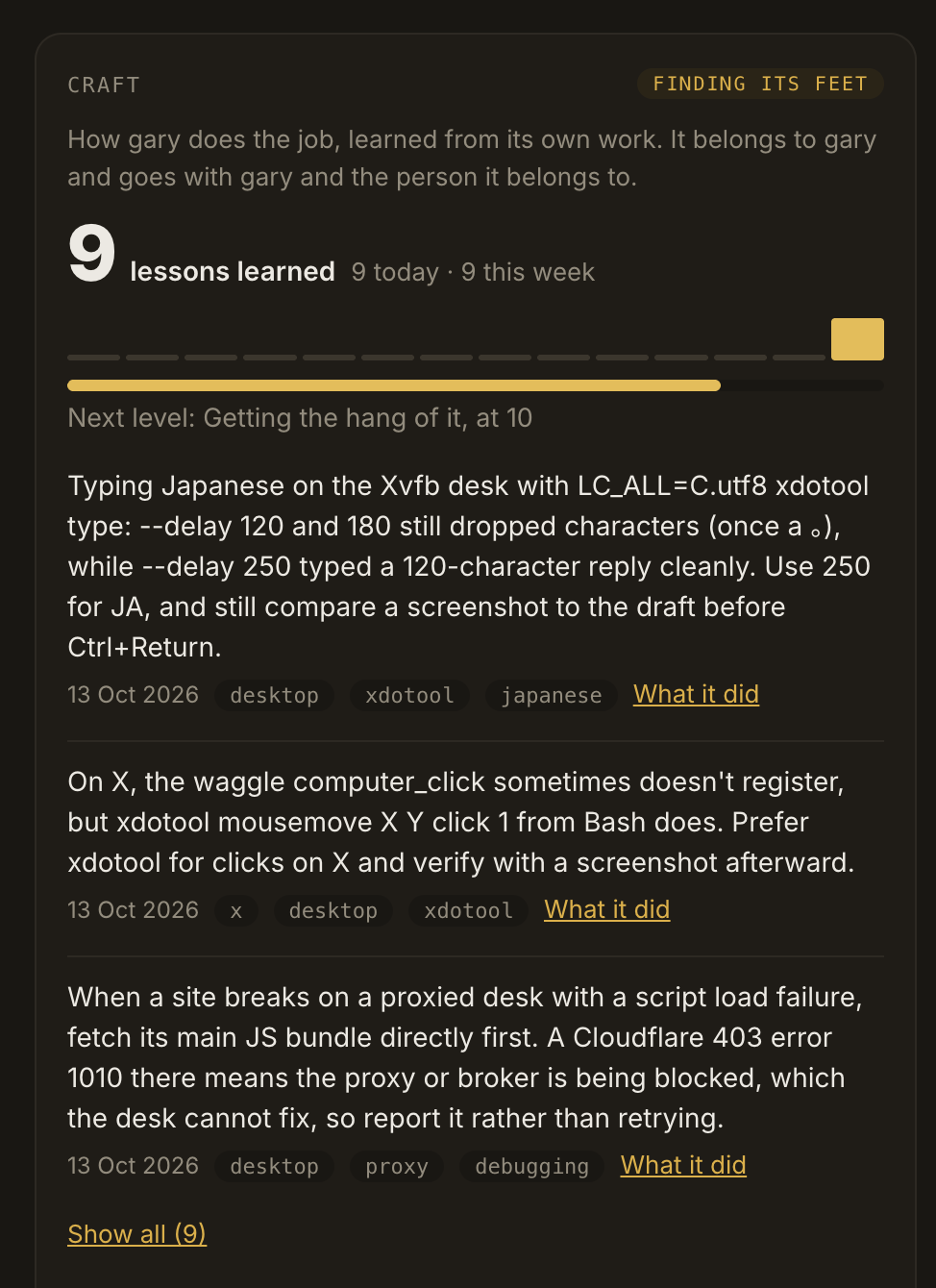
The agent's panel in the builder shows its craft: how many lessons it has learned, how many today and this week, and a strip of the last 14 days. Below that is a level: First lesson at 1, Finding its feet at 5, Getting the hang of it at 10, Skilled at 25, Experienced at 50, Expert at 100 and Master at 250.
Under the count are the notes themselves, newest first. Each one carries its date and its tags, and links to What it did, the trace of the work that produced it.
That link is the point. A lesson is a claim about the work, and you can open the work and check it. Trust in an agent that learns comes from seeing what it learned and being able to ask why.
An example: gary
gary is hachiflow's own marketing agent on Waggle. Its binding had kept everything in workspace memory, so it had recorded no craft at all. On 13 October 2026 we turned craft on, and it recorded 9 lessons that day.
Japanese typing on its virtual desktop needs xdotool --delay 250, because 120 and 180 dropped characters. On X, computer_click sometimes does not register, so it uses xdotool and checks a screenshot. A Cloudflare 403 with error 1010 on a proxied desk means the proxy is blocked, so it reports that instead of retrying.
Each of those is about a tool. None of the three says anything about who hachiflow sells to or what it charges. That is the kind of lesson craft is for.
Where this leaves us
An agent can get better at the job without carrying your business with it. Craft is on by default, a workspace Owner can turn it off, and every lesson links to the work that produced it.